Protein is everywhere these days, even in your Starbucks cup.
The popular coffee chain recently rolled out its new “ready-to-drink” (RTD) line in grocery stores across the country. These drinks contain 22 grams of protein, according to the company’s Feb. 26 announcement.
This new release should come as no surprise, as the coffeehouse has continued to build their catalog of protein drinks. The company initially hopped on the “protein craze” in Sep. 2025 when they launched in-store protein milks and cold foams, delivering up to 36 g of protein per one grande coffee.
Blayne Lapan, Williston’s Strength and Conditioning coach, believes Starbucks releasing protein drinks is “100% a gimmick,” following other brands’ footsteps.
“Health experts are doing a good job trying to get people to understand that intaking enough protein is critical,” he said. “Unfortunately, big brands also know this and try to sell more products … people see that it has more protein and equate the product with being ‘healthy’ which is just not the case.”
What started as one shelf dedicated to shakes and bars has cascaded into full aisles and stores for products containing this essential nutrient. Brand names including Doritos, KIND Snacks, Cheerios, and Thomas’ Breads have all reintroduced their most beloved products with the addition of protein.
Brooke Schlutter, a junior from Orange County, Calif., is on the same page as Lapan regarding the legitimacy of these new products.
“I think that’s a gimmick,” she said. “I don’t think that protein source is sustainable … I don’t think if you’re super serious about your protein inte [the Starbucks drinks] will be a fix-all.”
Brooke tried the Starbucks Protein Cold Foam and did not like it.
Sean Croft, a junior from Marshfield, Mass., acknowledges the purpose of the protein-filled drinks, but adds that people should still be conscious about what else is in the coffee.
“I think that it’s a good idea in theory, but at the same time I don’t think you can have a 1,300 calorie coffee with four sugars and eight creams and call it healthy just because there’s protein in it,” he said.
Instead of these mass-produced products, Sean implements protein by focusing on whole foods and “being conscious of what [he] eats, making sure [he] eats a lot of meat, eggs, and dairy to get [his] protein in.”
Brooke takes a similar approach, ensuring that she consumes protein during every meal and following every workout. Nutrition is a vital part of her muscle building and recovery.
“Whenever I’m feeling sore or have a hard workout, the first thing that comes to mind is how to recover,” she said. “I think the nutrition part plays a key role. Protein is what repairs your muscles, and your muscles need it.”
Lapan supports Brooke’s and Sean’s habits, emphasizing the importance of protein in every person’s lifestyle.
“As a culture we should try to ‘prioritize protein’ to help not over eat and as a part of a healthy diet,” he said.
Lapan suggests eating “one to two palm size portions of protein at each meal, and doing your best to eat that first.” Eating a portion of protein before the rest of your meal will ensure that you don’t overeat, he advises.
Sean believes that the current fixation on protein is due to social media.
“I think the fitness industry on social media has blown up in recent months and years and there are content creators, Sam Sulek and Alex Eubank, that are pushing high protein diets,” he said.
Sulek and Eubank are part of the most recent crop of fitness influencers, both known for popular Instagram content promoting body building, high protein, and intense training vlogs.
“I feel like [from social media] it’s kind of just bloomed … and companies have hopped on that,” Sean said.
Brooke agrees with Sean, adding that influencers also play a role in promoting diets and people bettering themselves.
“People are starting to take a lot more care of themselves; I think a lot of influencers have started that,” Brooke said. “I also think the diets as well, the keto diet — you see all these influencers endorsing that.”
The keto diet is a strict diet consisting of eating high-fat, protein, and low-carb foods in order to reach ketosis, a state the body reaches when it uses fat for fuel instead of glucose.
“Social media and influencing is a big part of [the protein craze],” Brooke adds.
This enthusiasm for protein dates back to the mid-1800s, when scientists identified carbohydrates, fats, and proteins as the primary macronutrients that provide the body with energy. Protein was specifically praised as an essential building block in the body. The first product dedicated to protein was introduced in the 1860s: a meat extract, sold in Europe by Justus von Liebig, a German scientist.
Lapan believes that while protein is essential, the recent fascination is just the latest installment of diet culture trying to sell consumers on a new fad.
“Big food has done this before, and for many years,” he said.
Protein Takeover: Starbucks to Doritos
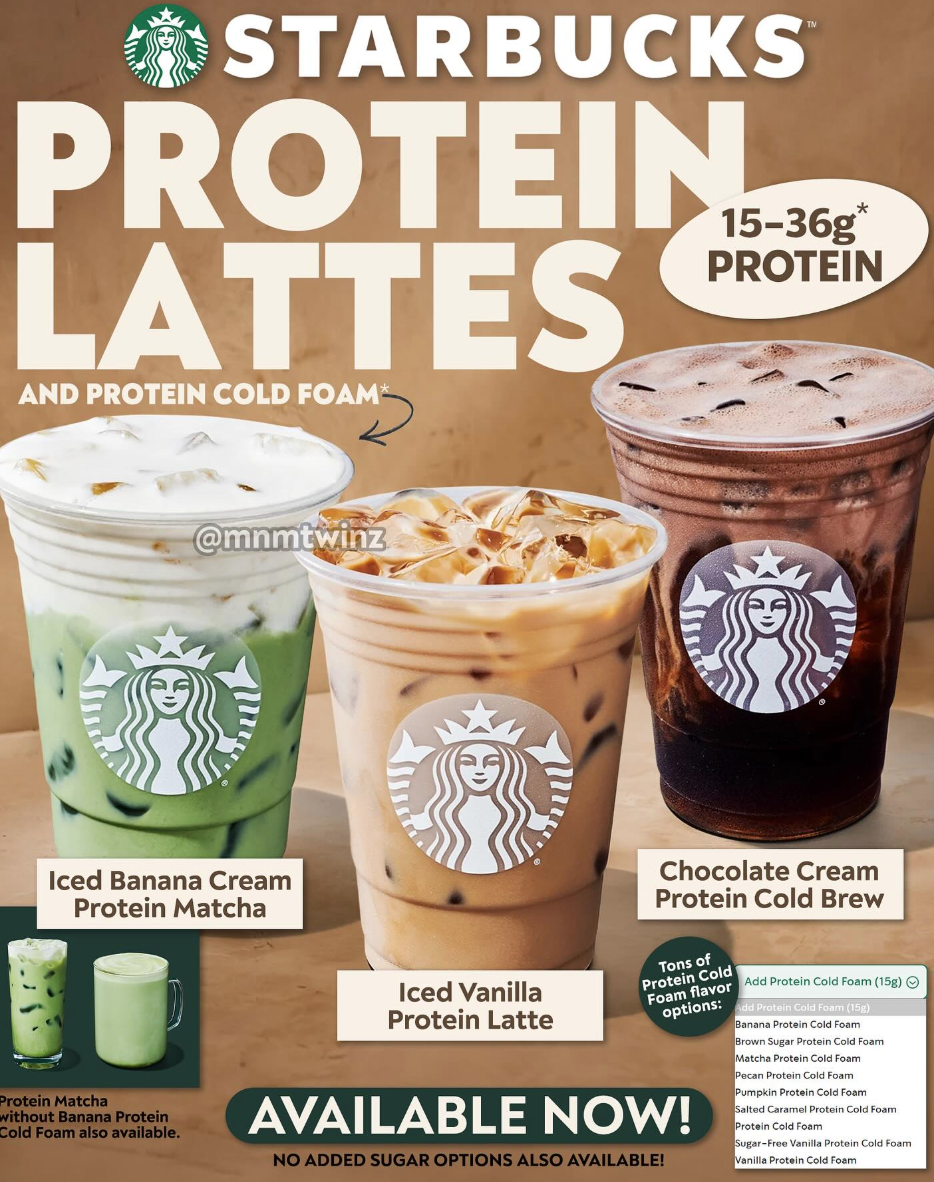
Credit: Instagram
More to Discover