


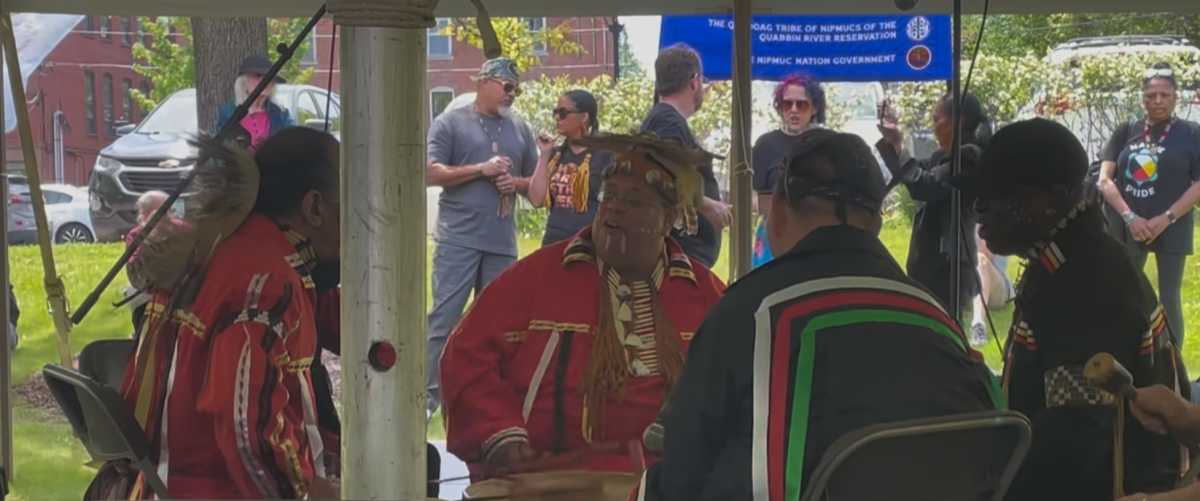
This past Saturday (May 16), the Great Falls Discovery Center in Turner’s Falls, Mass., was alive with the sound of music, conversation, familial greetings, and a promise to honor the past.
The event marked 350 years since the Great Falls Massacre, when, on May 16, 1676, Captain William Turner directed colonial troops to attack a refuge encampment next to the falls, killing 300 non-combatant, women, children, and elders. The encampment, Great Falls, Peskeompskut, just across the bridge from the Great Falls Discovery Center, had been home to Indigenous tribes throughout the Northeast for more than 12,000 years.
Saturday marked 350 years since the massacre. The Nolumbeka Project coordinated a day of remembrance called Remembering and Reconnecting, during which several speakers, musicians, and artists commemorated the tragedy and honored Sachem (Chief) Metacomet as well as the Indigenous people killed during the massacre. The Eastern Medicine Singers, an indigenous, intertribal group from Providence, R.I., sang in an Eastern Algonquian dialect.
Other performers and speakers included Liz Santana-Kiser, a Nimpuc community leader, artist, educator, and advocate; Strong Eagle ‘Many Feathers’ Daly, a Nimpuc tribe member and flute maker as well as player; Roger Longtoe Sheehan, Sagamo (Chief) of the Elnu Abenaki Tribe as well as a musician and educator, and others.
Colonial troops attacked hoping to demoralize Native forces in Metacom’s Resistance—commonly known as King Philip’s War. King Phillip’s War, according to the New England Historical Society, began with Plymouth County’s push into Native land, an unfair treaty, and the hanging of three Wampanoag people. Displaced people from neighboring tribes had gathered for respite near the falls as a familiar meeting place.
The English troops lost around 40 soldiers during the Massacre including Turner, which caused the village (contained within the current town of Montague) to be renamed as Turner’s Falls. In 2020, a petition to return to the name, Great Falls, gathered 3,402 signatures and a counter petition gained 1,888. However, the petition yielded no results and the village’s name remains.
The Great Falls Massacre is commonly considered the turning point in Metacomet’s Resistance, which ended with the death of Metacomet and 5,000 indigenous casualties, 1,000 of whom were peaceful noncombatants.
During the reception in the Great Falls Discovery Center, Wampanoag artists Deborah Spears Morehead and Robert Peters discussed their work with attendees. Asked by The Willistonian what they’d like people to understand, both emphasized consideration of Indigenous communities and their experience.
Peters recognized current movements with land acknowledgements but also described his wish for the people themselves to be recognized.
“I’d like the right considerations to be given,” he said. “Not just acknowledging the land, but the people of the land.”
Several colleges have begun to release land acknowledgements, recognizing the Native populations whose land in which they reside. Some colleges near Easthampton include Mount Holyoke, Smith College, and UMass Amherst. Similarly, the Forbes Library in Northampton and the Boston Library have acknowledgements on their websites. Williston has not released a land acknowledgement.
Despite these acknowledgements, Native people still face erasure in academia and the public eye.
According to a lecture given in 2022 at Berkshire Community College by Dr. Margaret M. Bruchac—who also attended the Remembering and Reconnecting event—academia has painted Native Americans as extinct by solely basing conversation and documentation on bones, artifacts, and physical records without any consultation of living Indigenous populations. Without proper restorative methodologies, this “vanishing act” causes the current and damaging recolonization of Indigenous peoples who are treated as history rather than real, living groups.
An important aspect of preventing incorrect methods when honoring and remembering Indigenous populations is including them themselves, said Deborah Spears Morehead.
“Nothing about us without us,” she said.
She also commented that she’d like people to be aware of the continued oppression that Native people face.
“Colonization tactics are still intact to destroy us, and we are still here, strong and fighting them,” she said. “It’s important to learn about them so you know when they are happening.”
Morehead added that these tactics may appear small to those who don’t experience them or understand them, but are obvious to those hurt by them.
“It’s subtle but it doesn’t feel subtle,” she described. She likened it to “a pile of rocks; one rock may not be much but each one you add it gets heavier and eventually your tolerance gets low.”
Natalie R. Montoya-Barnes, the Center and Program Coordinator for the Davis Center at Williams College, who also attended the event, said that it’s important to remember events like the Great Falls Massacre in order to make better choices in the future.
“The more we remember, the better we do for our future,” she said.
She added that similar violence and injustice is ongoing in the modern world.
“If you learn about King Phillip’s War, it sounds like Israel and Palestine today,” she lamented. “But it’s not just Israel and Palestine, things like this happen everywhere. It’s overwhelming.”
But we are not hopeless, emphasized Montoya-Barnes.
“I can work to make today better,” she said.
The last line of the Reconciliation Agreement signed on May 19, 2004 reads: “As we exchange gifts, ideas and good will today, we commit to a future that will continue the exchange of actions to promote understanding about and between the cultures, increase mutual vigilance for historic preservation, and deepen our appreciation for the rich heritage of the indigenous peoples of our region and all who have found respite, sanctuary and welcome here.”





Miranda Rivera • May 22, 2026 at 12:08 PM
Very well written article!